
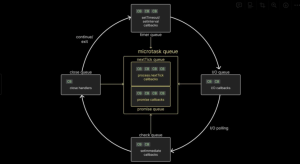
Node.js is renowned for its ability to handle thousands of concurrent connections with ease, thanks to its powerful event-driven, non-blocking I/O architecture. At the heart of this architecture lies the Event Loop, a process that schedules and executes asynchronous tasks. To truly grasp how Node.js manages its operations, it’s essential to understand its phases within the Event Loop and the crucial role played by libuv.
The Node.js Event Loop: An Overview
Unlike traditional blocking I/O models, Node.js operates on a single-threaded event loop that processes various types of tasks in a well-defined sequence. This loop is divided into multiple phases, each responsible for specific kinds of callbacks, timers, or I/O operations.
The main phases are:
- Timers
- I/O Callbacks
- Idle, Prepare
- Poll
- Check
- Close Callbacks
Let’s explore each phase in detail.
Phases of the Node.js Event Loop
1. Timers
Purpose: Executes callbacks scheduled by `setTimeout()` and `setInterval()`.
How it works: When the event loop enters the Timers phase, it checks whether the scheduled time for timers has elapsed. If so, their callback functions are executed.
Example:
“`javascript
setTimeout(() => {
console.log(‘Timeout callback’);
}, 1000);
“`
2. I/O Callbacks
Purpose: Handles almost all callbacks related to system I/O operations, such as TCP errors, socket events, or other system events.
How it works: After timers, the event loop processes I/O callbacks that are deferred from previous operations.
Example: Callbacks from network or filesystem operations.
3. Idle, Prepare
Purpose: Internal phase used for preparing the event loop to execute the poll phase. It is mainly for internal use.
Note: Developers rarely interact directly with this phase.
4. Poll
Purpose: Waits for incoming connections, I/O events, or timers to become ready. It is the most complex phase.
How it works:
– If there are I/O events or timers ready, the poll phase executes their callbacks.
– If there are no events, Node.js will wait (block) for events to occur or for a timeout period.
Special behavior:
– If scripts have scheduled callbacks, the poll phase executes them.
– If no events are pending, the poll phase may block for a specified timeout or exit if timers are due.
5. Check
Purpose: Executes callbacks scheduled by `setImmediate()`.
How it works: After the poll phase, the event loop enters the Check phase, where `setImmediate()` callbacks are invoked.
6. Close Callbacks
Purpose: Handles callbacks for closing events, such as `socket.on(‘close’)`.
Example:
“`javascript
socket.on(‘close’, () => {
console.log(‘Socket closed’);
});
“`
Visual Summary of the Phases
Order | Phase Name | Description |
1 | Timers | Executes scheduled timers |
2 | I/O Callbacks | Handles deferred I/O callbacks |
3 | Idle, Prepare | Used internally by the system |
4 | Poll | Retrieves new I/O events |
5 | Check | Executes setImmediate() callbacks |
6 | Close Callbacks | Handles close events (e.g., sockets) |
The event loop cycles through these phases repeatedly, enabling Node.js to process asynchronous operations efficiently.
The Role of libuv
What is libuv?
libuv is an open-source multi-platform C library that provides the core event-driven I/O functionalities for Node.js. It acts as an abstraction layer over the operating system’s native APIs, enabling Node.js to perform asynchronous I/O across various platforms seamlessly.
How does libuv work?
- Event Demultiplexing: libuv uses system-specific mechanisms such as `epoll` (Linux), `kqueue` (macOS), or `IOCP` (Windows) to monitor multiple file descriptors, sockets, or events efficiently.
- Thread Pool: For operations that can’t be performed asynchronously natively (like file system operations), libuv maintains a thread pool to offload tasks.
- Task Scheduling: libuv manages the scheduling of I/O events and callback invocation based on the current phase of the event loop.
Key Responsibilities:
- Polling for I/O events
- Managing timers
- Handling asynchronous file system operations
- Managing TCP, UDP, and other network protocols
- Providing cross-platform compatibility
Conclusion
Understanding the phases of the Node.js Event Loop provides insight into how asynchronous operations are managed behind the scenes. Each phase has a specific purpose, enabling Node.js to deliver high concurrency and performance.
Complementing this is libuv, the powerful C library that abstracts platform-specific I/O mechanisms, manages thread pools, and ensures that Node.js can perform efficient, non-blocking I/O operations across all supported operating systems.
Together, the Event Loop and libuv form the backbone of Node.js’s asynchronous, event-driven architecture, empowering developers to build scalable, high-performance applications.